
2026 vintage
2026 Vintage: The Rhône Valley surprises
Contents
Introduction
Early, sunny, and demanding, the 2026 vintage has put the vineyards of the Rhône Valley to the test. After winter and spring were marked by rainfall, replenishing soil water reserves, heat waves and summer drought accelerated ripening, requiring constant vigilance from winegrowers. Yet, from the northern vineyards to the southern appellations, one conclusion is clear from the first tastings: 2026 surprises with its balance, freshness, and quality potential.
In many appellations, the harvest began exceptionally early, sometimes as early as mid-August. Adapting to the different terroirs and precisely adjusting harvest dates were therefore crucial to preserving the balance of the wines.
While the profiles naturally differ across the region, the first wines reveal a beautiful aromatic intensity. The reds stand out for their structure and maturity, while the whites and rosés unveil expressive aromatic profiles and preserved freshness. After a particularly demanding vintage, 2026 thus appears to be a year of contrasts and surprises.
According to Samuel Montgermont, president of Inter Rhône:
“the exceptional weather conditions this year had raised real concerns about the harvest's potential. The 2026 vintage ultimately held a very pleasant surprise. It turned out to be a vintage as unpredictable as it is promising, which has defied many predictions and testifies, once again, to the extraordinary resilience of the vine in the face of climatic hazards.”
In the northern Rhône, unexpected concentration and balance
At the northernmost end of the Rhône Valley, on the slopes of the Côte-Rôtie appellation, the heat and rapid ripening demanded a swift response. The first grapes were harvested on August 15th, before the rains of the second half of August furthered the ripening process. Despite a harvest expected to be about 20% lower than the appellation's yield, the first tastings reveal dense and concentrated wines. “The wines are powerful and full-bodied, dense and intense. The surprise lies in the balance of the wines, which prove to be very harmonious, and above all, to have great aging potential,” reveals Marcel Guigal, co-president of Côte-Rôtie appellation.
In Condrieu, the 2026 vintage confirms the early ripening trend of recent years, with the harvest beginning around August 22. Despite severe drought and several heat waves, the few summer rains and the significant water reserves accumulated during a particularly wet winter and spring allowed the vines to maintain excellent health and growth. Pierre-Jean Villa, co-president of Condrieu AOC, highlights a result that is as pleasing as it is surprising: “The quantities are there, and the quality promises to be remarkable.”
In Hermitage AOC, the heat was also a defining characteristic of the vintage, without, however, disrupting the balance of the wines. The water reserves built up in the spring allowed the vines to better withstand the high temperatures. The white grapes were harvested very early, as early as August 15, to preserve their freshness.
Jacques Desvernois, co-president of Hermitage AOC, declares: “The whites are harmonious and full-bodied, with a very long finish. [...] The reds are colorful, powerful, and exceptionally precise. An out-of-the-ordinary vintage for meteorologists, but mastered by the winemakers, very complete and balanced.”
In Cornas, after a relatively small 2025 harvest, volumes are returning to near-normal levels. Nicolas Serette, co-president of the AOC, emphasizes: “The grapes are perfectly ripe and the first tastings are encouraging, revealing structured wines with a beautiful aromatic expression.”
In Saint-Péray, spring rains and a beautiful emergence of grape bunches suggested a promising harvest before a particularly dry summer, marked by six successive heatwaves. In particular, the old vines withstood these extreme conditions remarkably well. Lionnel Fraisse, co-president of Saint-Péray AOC, states that “Despite these extreme conditions and the lack of rainfall, the vines offered a very good juice yield and particularly promising balances. [...] An exceptional vintage, marked by the vineyard's adaptation and a very high quality potential.”
On the southern border of the Northern Rhône, in the Diois region, the harvest began on August 11, making 2026 the earliest vintage ever recorded in the area's AOCs. Despite some variation depending on the sector and on summer rainfall, the overall result is considered quite exceptional by Fabien Lombard, co-president of the Diois AOCs: “The Muscat grape variety expressed itself remarkably well, but the Clairette, in an extreme climatic context, once again demonstrated a particularly strong resistance to heat and gave satisfaction in terms of both taste and volume.”
IN THE SOUTHERN RHÔNE, A DEMANDING VINTAGE THAT REVEALS HIGH POTENTIAL
Further south, the heat and drought also strongly influenced the 2026 vintage. But the accounts converge on one point: the balances obtained are often better than what the summer conditions could have predicted.
In Cairanne, after a rainy spring followed by a scorching, very dry summer, rainfall at the beginning of September allowed for a reassessment of the harvest dates and helped in searching for a more balanced harvest. Beginning on August 20, the harvest continued until the beginning of October.
Laurent Brusset, co-president of Cairanne AOC, enthuses: “A surprising, challenging, demanding vintage, but ultimately of high quality! [...] The alcohol-acidity balance is perfect, the aromas are expressive, and the tannins are fine and supple.”
The same story is heard in neighboring Rasteau: despite successive heat waves between June and August, the vintage is shaping up to be more bountiful than in 2025. Work in the cellars required particular attention to achieve color and extraction while maintaining balance. “Ultimately, a promising vintage, with beautiful balances in prospect,” declares Frédéric Lavau, co-president of Rasteau AOC.
In Lirac, the first impressions of François Miquel, co-president of Lirac AOC, are also very positive: “A vintage full of surprises and very promising in both white and red.”
In Duché d’Uzès, Jérôme Guibal, co-president of the AOC, notes that the harvest was about ten days ahead of schedule. Initial tastings reveal concentrated and structured reds, while whites and rosés stand out for their aromatic intensity and freshness.
In Ventoux, despite record-breaking early ripening, the altitude plays a crucial role in maintaining the balance. Frédéric Chaudière, co-president of Ventoux AOC, is delighted: “The grapes are fully ripe and promise a rich and flavorful vintage that will nevertheless remain balanced thanks to the cool climate of our mountains.”
In the Costières de Nîmes region, the significant rainfall during winter and spring replenished water reserves, while sea breezes helped to temper the intense summer heat. According to Michel Gassier, co-president of Costières de Nîmes AOC, yields appear generous and the first wines are particularly encouraging, with whites and rosés displaying “excellent balance, surprising freshness, and beautiful aromatic expression, and reds showing maturity, balance, and potential.”
Côtes du Rhône: A long harvest period to preserve the balance
Further south, the heat and drought also strongly influenced the 2026 vintage. But the accounts converge on one point: the balances obtained are often better than what the summer conditions could have predicted.
In Cairanne, after a rainy spring followed by a scorching, very dry summer, rainfall at the beginning of September allowed for a reassessment of the harvest dates and helped in searching for a more balanced harvest. Beginning on August 20, the harvest continued until the beginning of October.
Laurent Brusset, co-president of Cairanne AOC, enthuses: “A surprising, challenging, demanding vintage, but ultimately of high quality! [...] The alcohol-acidity balance is perfect, the aromas are expressive, and the tannins are fine and supple.”
The same story is heard in neighboring Rasteau: despite successive heat waves between June and August, the vintage is shaping up to be more bountiful than in 2025. Work in the cellars required particular attention to achieve color and extraction while maintaining balance. “Ultimately, a promising vintage, with beautiful balances in prospect,” declares Frédéric Lavau, co-president of Rasteau AOC.
In Lirac, the first impressions of François Miquel, co-president of Lirac AOC, are also very positive: “A vintage full of surprises and very promising in both white and red.”
In Duché d’Uzès, Jérôme Guibal, co-president of the AOC, notes that the harvest was about ten days ahead of schedule. Initial tastings reveal concentrated and structured reds, while whites and rosés stand out for their aromatic intensity and freshness.
In Ventoux, despite record-breaking early ripening, the altitude plays a crucial role in maintaining the balance. Frédéric Chaudière, co-president of Ventoux AOC, is delighted: “The grapes are fully ripe and promise a rich and flavorful vintage that will nevertheless remain balanced thanks to the cool climate of our mountains.”
In the Costières de Nîmes region, the significant rainfall during winter and spring replenished water reserves, while sea breezes helped to temper the intense summer heat. According to Michel Gassier, co-president of Costières de Nîmes AOC, yields appear generous and the first wines are particularly encouraging, with whites and rosés displaying “excellent balance, surprising freshness, and beautiful aromatic expression, and reds showing maturity, balance, and potential.”
Across the Côtes du Rhône region, the exceptionally long harvest period perfectly illustrates the unique characteristics of this vintage. The harvest extended from the beginning of August until mid-October. Despite the heat and drought, the grapes were deemed to be in very good condition, although yields varied depending on the terroir. Damien Gilles, president of Syndicat Général des Côtes du Rhône, offers an initial assessment: “The first feedback is very encouraging and suggests great potential for quality, with wines that are fresh and elegant. Alcohol levels were perfectly controlled for such a hot year.”
At the end of a winegrowing season marked by particularly demanding weather conditions, the 2026 vintage once again confirms the uniqueness and diversity of the Rhône Valley vineyards. From the northern slopes to the southern terroirs, winemakers have successfully navigated the vagaries of the climate, adapted their practices, and demonstrated precision in their choices, from vineyard to cellar, to bring out the best in each terroir.
Despite exceptional earliness and periods of intense heat, the first tastings reveal wines with promising profiles, where maturity and concentration are accompanied by an often unexpected freshness. While the aging process still needs to refine its expression, 2026 is shaping up to be a vintage of character, rich in nuances and contrasts, illustrating both the richness of the Rhône terroirs and the expertise of those who cultivate them.
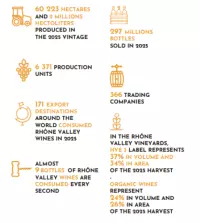
Key figures
Vintages
Discover the latest vintages
From year to year, discover the particularities of each harvest of the Rhône Valley.
